
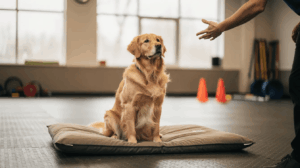
Place command dog training teaches your dog to go to a designated spot and remain there until you give a release cue. Depending on how you define the behavior, that spot may be a mat, dog bed, raised cot, platform, or another clearly defined surface. Place can be useful for managing situations such as guest arrivals, meal preparation, and other busy household routines.
This guide covers the place command training process, from the first introduction to practicing around everyday distractions. It can be adapted for puppies and adult dogs based on their age, attention span, training history, and individual needs. A place surface can be a mat, dog bed, raised cot, platform, or another stable, clearly defined area. For information about local training options, visit the Syracuse dog training homepage.
After reading this guide, you will understand how to:
- Teach the basic place command using rewards and a marker word or clicker
- Build duration gradually
- Troubleshoot common challenges such as leaving before the release cue
- Select an appropriate place surface for your dog’s size and training goals
- Integrate place into daily routines such as meal preparation and greeting guests
Understanding the Place Command
The place command directs a dog to move to a specific location and remain within the defined area until released. The exact criteria can vary: some trainers require all four paws on the surface, while others teach the dog to settle in a particular position. Unlike confinement in a crate, place generally keeps the dog in an open area while establishing a clear physical boundary.
What Place Command Means
At its simplest, place means “go to this designated area and remain there until released.”
Three useful elements are:
- Boundary: The mat, dog bed, raised cot, platform, or other defined area that tells the dog where to remain.
- Clear criteria: Decide what counts as being on place and use the same expectation consistently.
- Release cue: A specific word such as “free,” “break,” or “okay” that tells the dog the exercise has ended.
The criteria for place should remain consistent once you decide how you want the behavior to look. Some versions allow the dog to change position while remaining on the designated surface. Place is also included in Syracuse dog obedience training programs, and the local Basic Marker Mastery™ program specifically includes learning the Place command using reward-based marker training.
For another overview of how the behavior can be taught, see the American Kennel Club guide to teaching a dog to go to their place.
How Place Differs from Stay
Place and stay are related but distinct behaviors. Place generally sends the dog to a particular surface or defined area, while stay asks the dog to remain where the cue was given. A mat, cot, or other place surface provides a visible physical boundary that can make the target easier for the dog to identify.
Whether the dog must maintain a specific body position during either behavior depends on the criteria you teach. For example, a sit-stay may require the dog to remain sitting, while other stay exercises may allow a position change as long as the dog remains in the designated location.
The important part is establishing clear, consistent expectations and a release cue.

Benefits of Place Command Training
Place training can support household management, waiting skills, and clearer routines when it is taught consistently and practiced at an appropriate difficulty level.
Practicing Waiting and Self-Control
The place command allows dogs to practice remaining in one area instead of immediately approaching people, food, toys, or other distractions. Repeated successful practice can help build better waiting skills and clearer responses to the cue.
Place can also provide an alternative behavior during situations such as doorbell rings or guest arrivals. Instead of allowing the dog to rush toward the activity, the owner can cue the dog to move to the designated surface and reinforce staying there. The American Kennel Club’s Place training guide also describes using the behavior during situations such as visitors and meal preparation.
The difficulty should be increased gradually so the dog can continue succeeding as distractions become more challenging.
Place for Anxious or Reactive Dogs
For some anxious or reactive dogs, a well-trained place behavior can be useful as part of a broader management plan. A familiar mat or bed may give the owner a predictable location to reinforce settled behavior, but the dog should not be forced to remain close to a trigger that is causing fear or distress.
Place training is not a treatment for anxiety, fear, or reactivity by itself. Dogs with significant behavior concerns may need individualized management, gradual desensitization and counter-conditioning, professional behavior support, and, in some cases, veterinary evaluation. The American Veterinary Society of Animal Behavior’s behavior and training resources provide additional guidance on humane training and behavior modification.
Syracuse owners dealing with more significant fear, anxiety, aggression, or reactivity can also review the local reactive, fearful, and aggressive dog training options.
Training should progress at a level where the dog can remain comfortable and responsive.
Household Management Tool
Using place can help manage dogs during busy activities. Sending your dog to place while making dinner can keep them away from counters and reduce opportunities to beg or get underfoot. When guests arrive, place can provide an alternative to approaching or jumping on visitors, provided the behavior has been practiced at an appropriate distraction level.
Place is also portable and flexible. You can practice with the same mat in different areas of the house, in the yard, and eventually in other suitable environments.
Unlike confinement, place can keep the dog in the shared living space while establishing clear expectations about where they should remain.
How to Teach Place Command Training
Teaching place follows a layered approach: first the dog learns the value of the surface, then the meaning of the cue, and then how to remain there for increasing duration, distance, and distraction levels.
Learning speed varies depending on the dog’s age, training history, motivation, environment, and consistency of practice.
Step-by-Step Training Process
Before starting, choose a stable place or surface, small rewards appropriate for your dog, and a marker word or clicker if you use one. A leash can also be useful for safe management during early practice. If you want to learn more about marker-based training locally, Syracuse’s Basic Marker Mastery™ program includes clicker work, reward-based training, and the Place command.
Keep sessions short enough that your dog remains engaged and successful. Start in a low-distraction area before gradually increasing difficulty. A quiet room with minimal foot traffic is a practical starting point.
- Establish your release cue. Choose a word such as “free,” “break,” or “okay” and use it consistently to signal that your dog may leave the place surface.
- Introduce the place surface. Set the mat, cot, bed, or platform down and allow your dog to investigate it. Mark and reward appropriate interaction with the surface.
- Guide the dog onto the surface. Use a treat or hand target to encourage your dog onto the designated area. Mark and reward when the dog meets the criteria you have chosen.
- Add the verbal cue. Once the dog reliably moves onto the surface, say “place” just before giving the familiar hand signal or movement. With repetition, gradually reduce the extra prompting.
- Fade the lure. Reduce your hand movement gradually until the dog can respond to a smaller gesture or the verbal cue.
- Build duration. Start with a duration your dog can easily manage and reward while the dog remains on the surface. Increase the time gradually. If your dog leaves early, calmly reset and make the next repetition easier rather than repeatedly practicing at a level that is too difficult.
- Increase distance. Once the dog can remain on place for a short period, begin moving a small distance away and returning to reward. Increase distance gradually while keeping the dog successful.
- Add distractions and generalize. Work on duration, distance, and distractions gradually, changing one major variable at a time. Practice in different rooms and environments only after the dog understands the behavior at easier levels. Introduce distractions at an intensity your dog can handle successfully.
The AKC’s step-by-step Place training instructions provide another useful reference for gradually developing duration, distance, and distraction skills.
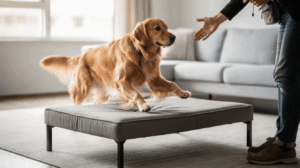
Equipment and Surface Comparison
The surface you choose can affect how clearly your dog recognizes the place boundary.
| Criterion | Raised Cot | Flat Non-Slip Mat | Dog Bed | Elevated Platform |
| Portability | Moderate | High | Moderate | Low |
| Boundary Definition | Clear | Moderate | Varies by design | Clear |
| Ease of Storage | Varies | High | Varies | Low |
| Best Use | Home or portable practice | Travel and flexible practice | Familiar household target | Structured stationary practice |
A raised cot or platform can provide a particularly obvious physical boundary, while a flat mat is easier to transport. A dog bed can also work if the dog understands that the place cue means remaining on the designated surface until released.
Whichever surface you choose, make sure it is stable and appropriately sized for your dog.
Common Challenges and Solutions
Dogs may encounter different sticking points while learning place. When problems occur, adjusting the difficulty is usually more useful than repeatedly asking for a behavior the dog does not yet understand.
Dog Won’t Stay on the Place Surface
If your dog steps off shortly after getting onto the surface, the required duration may be too difficult.
Shorten the hold to something the dog can successfully manage and reward while the dog remains on place. Gradually increase the duration after several successful repetitions.
Also check the surface itself. A slippery mat, an undersized surface, or a location with excessive traffic or distractions can make the exercise more difficult.
Breaking Before the Release Cue
If your dog leaves before the release cue, calmly guide or cue them back when appropriate and make the next repetition easier.
Shorten the duration, reduce the distraction, or stay closer to your dog. Reward successful repetitions while the dog remains on the designated surface.
Consistent criteria and appropriately challenging practice are more useful than repeatedly testing the dog at a level where they cannot succeed.
Difficulty Building Duration
If your dog succeeds at one duration but repeatedly leaves when you increase the time, the difficulty may have increased too quickly. Return to an easier duration and build in smaller steps.
Keep sessions short and productive rather than continuing until the dog becomes disengaged.
During longer repetitions, reinforce the dog while they are still on place. As the behavior becomes more reliable, you can gradually vary the timing of rewards while maintaining clear criteria and a consistent release cue.
If you need help teaching place or working through broader obedience or behavior concerns, private dog training in Syracuse can provide structured instruction based on your dog’s individual needs.
Conclusion and Next Steps
The place command gives your dog a clear task: move to a designated area and remain there until released. With consistent practice, it can become a useful household-management and obedience skill during meals, guest arrivals, quiet time, and other everyday situations.
To get started:
- Choose a stable mat, bed, cot, or platform that clearly defines the target area.
- Begin with short sessions in a quiet environment.
- Establish a consistent release cue.
- Build duration, distance, and distractions gradually rather than increasing everything at once.
If you want professional help building obedience skills such as place, review the current Plans & Pricing page or contact the Syracuse team to discuss available training options.
Frequently Asked Questions
How long does it take to train a dog to reliably respond to the place command?
There is no universal timeline. Progress depends on your dog’s age, training history, environment, motivation, and how consistently you practice. Begin with easy repetitions and increase difficulty gradually.
Can the place command help with a dog that jumps on guests?
It can help with management by giving your dog an alternative behavior during guest arrivals. Practice the cue before using it around visitors, and increase the distraction level gradually. The AKC’s guidance on teaching Place also discusses using the behavior as an alternative during visitor arrivals.
What should I do if my dog keeps leaving place before I release them?
Make the exercise easier by shortening the duration, reducing distractions, or staying closer to your dog. Calmly reset when needed and reward successful repetitions while your dog remains on place.
Is the place command suitable for anxious or reactive dogs?
It may be useful as one management or training skill, but place alone does not treat anxiety or reactivity. Dogs with significant fear, anxiety, or reactive behavior may need an individualized behavior plan and professional or veterinary guidance. Syracuse owners can review behavior training for reactive, fearful, or aggressive dogs for local options.
What type of surface is best for teaching the place command?
Choose a stable, appropriately sized surface with a boundary your dog can easily recognize. Raised cots, platforms, non-slip mats, and dog beds can all work depending on your training goals and where you plan to practice.
How do I integrate the place command into daily routines?
Practice place during manageable household activities such as meal preparation, cleaning, or quiet time. Once the behavior is reliable, gradually practice around additional distractions and in different environments.
